ENDE – European Network on Digitalization and E-governance
Project Focus
The ENDE project (Jean Monnet Network) explores e-governance and digital transformation within the EU. It connects leading experts to analyze and implement the digital agenda in political, economic, and social contexts. The project aims to understand how digital policies shape the perception of the European Union and influence the daily lives of its citizens.


Project Website: https://proxectoende.webs.uvigo.es/
Partnership
- TALLINNA TEHNIKAÜLIKOOL,
- UNIVERSIDAD DE VIGO,
- UNIVERSITA DEGLI STUDI DI MACERATA,
- UNIVERZITA PALACKEHO V OLOMOUCI,
- UNIVERZITA KOMENSKEHO V BRATISLAVE,
- ALMA MATER STUDIORUM – UNIVERSITA DI BOLOGNA,
- FAKULTETA ZA UPORABNE DRUŽBENE ŠTUDIJE V NOVI GORICI,
- KOC UNIVERSITY,
- UNIWERSYTET WROCLAWSKI,
- RIGAS JURIDISKA AUGSTSKOLA SIA,
- TURUN YLIOPISTO,
- UNIVERSIDADE DO MINHO,
- UNIVERSIDAD DE VALLADOLID,
- INSTITUTE FOR EUROPEAN STUDIES
Short description of the project
ENDE focus on E-governance and Digital transformation in the European Union. It is a network including prestigious experts on digital transformation holding Jean Monnet actions on digital aspects (Module, Chair or Center of Excellence). At a historical period of renovation in the paradigm of society, E-Governance and digitalization have seen their implementation accelerated by the recent COVID-19 pandemic. Therefore, understanding, suggesting adequate implementation and promoting such a change in the model of civilization is a priority as scientific target of the network. The main working areas are related to the practical implementation of E-governance in the European Union, including areas as politics, economy, law, international relations and social aspects. The objective is understanding and foreseeing the fast development on the digital agenda that can change completely the perception of the European Union, its influence over the citizen lives and the external scope of the organisation.
Project news
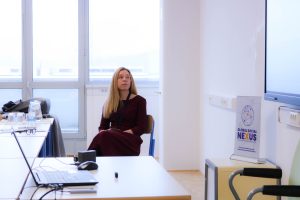
On 16 May 2026, Prof. Dr. Mateja Rek presented her paper, Digital Marketing Communication Awareness and Democratic Resilience: Policy Implications for European Digital Governance, at the international scientific conference Global Social Nexus 2026: Societies in Flux: Navigating Uncertainty, Change and Resilience. The conference was organized by the School of Advanced Social Studies (FUDŠ) in Ljubljana to mark its 20th anniversary and took place on 15–16 May 2026 in Ljubljana, Slovenia.
In her presentation, Prof. Rek emphasized that individuals in today’s digital environment are exposed on a daily basis to personalized and algorithmically driven forms of digital marketing communication, including targeted advertising, influencer marketing, sponsored content, and platform recommendations. As the boundaries between informational and promotional content become increasingly blurred, understanding these mechanisms is becoming essential for critically evaluating information, making autonomous decisions, and strengthening democratic resilience. She argues that awareness of digital marketing communication should be recognized as an integral component of media literacy and educational policy. Among its key recommendations are the integration of digital marketing topics into media literacy education programmes, increased transparency of digital platforms, and the development of competencies that enable individuals to recognize persuasive strategies and understand the functioning of algorithms.
Within the framework of the ENDE project (European Network on Digitalization and E-Governance), educational materials for seminars have been developed with the aim of promoting a deeper understanding of digitalization processes in the European Union. The materials address key aspects of digital transformation, including the impact of digital technologies on democratic processes, public administration, the economy and civil society. The educational materials are designed in an interdisciplinary manner and are intended for a broad range of users. A particular value of these materials lies in their ability to connect theoretical concepts with current examples of good practice, enabling an understanding of the challenges and opportunities that digitalization brings at both the EU and member state levels. To increase accessibility and broader use, the materials have been translated into Slovenian, thereby contributing to knowledge transfer and the strengthening of digital competencies in Slovenia.
Within the framework of the DIGI.DR project – Strengthening Digital Citizenship in Slovenian Educational Institutions, a professional seminar entitled Active Youth E-Participation: Developing Digital Competences for Civic Participation was held on 11 December 2025 at the Faculty of Education, University of Ljubljana. The event was dedicated to an in-depth reflection on the role of digital technologies in fostering active citizenship, with a particular focus on young people. The keynote contribution was delivered by Prof. Dr. Mateja Rek, who in her presentation E-Democracy in the EU – A Civil Society Perspective outlined the key concepts, tools and challenges of e-democracy within the European Union. The presentation drew on expert materials and research outcomes of the European Network on Digitalization and E-Governance (ENDE), a Jean Monnet network focusing on digital transformation and e-governance in the EU. Through expert contributions and a concluding discussion, the seminar provided a platform for the exchange of good practices and supported the objectives of the DIGI.DR project in developing content and approaches to strengthen digital citizenship in educational settings.

On Tuesday, 9 December 2025, a professional seminar dedicated to the challenges of disinformation in the digital environment was held for students of the Media and Journalism study programme. The seminar was organised within the framework of the Ne/ja – Myth Buster project and hosted as part of the ENDE project (European Network on Digitalization and E-Governance). The seminar was delivered by journalists from the Slovenian Press Agency (STA), who provided participants with insights into contemporary journalistic practices and approaches to identifying and countering disinformation. The event encouraged reflection on the impact of digitalisation on the media landscape, as well as on the challenges that disinformation poses to public debate, democratic processes and the understanding of social issues related to young people. Participants were introduced to journalistic fact-checking practices, methods for recognising disinformation and the importance of responsible and ethical reporting. The seminar offered a space for the exchange of experiences and discussion on strengthening media literacy in the digital environment and contributed to the objectives of the Ne/ja and ENDE projects, which promote critical thinking, an informed public and active citizenship.


As part of the Jean Monnet EU Network for Digitalisation & E-Governance (ENDE) project, a seminar for young professionals in media, journalism, digital production and media management was held on 2 December 2025 in Ljubljana. Today’s digital environment demands a high level of professional expertise, proficiency in digital tools and a strong understanding of the media’s influence on society. Content creators, journalists and media producers play an increasingly important role in safeguarding democratic values, as their work shapes public opinion, disseminates verified information and encourages active citizenship. The seminar focused on understanding current challenges of digital transformation and the role of civil society in the European digital sphere. It was based on materials developed within the ENDE project, which address the impact of digitalisation on democratic processes, political participation and new forms of communication between citizens and decision-makers. Participants gained valuable insights into key societal shifts brought about by the digital revolution and into the demands that the new communication landscape places on future media professionals.

A specialized seminar for doctoral students of the Strategic Communication study programme was held as part of the ENDE project – European Network for Digitalisation and e-Governance, funded by the Erasmus+. The event was attended by doctoral students who are employed in public administration and the business sector, which enabled a particularly valuable dialogue between research approaches and practical experience from their professional environments. The seminar addressed key challenges and directions of digital transformation in the EU, with a special emphasis on understanding the effects of e-government on citizens and on shaping future information and communication policies. The seminar also presented examples of current research contributions developed within the ENDE network, including articles on digital citizenship, resilience to disinformation, and a conceptual framework for media literacy in the digital environment. Participants had the opportunity to analyse various methodological approaches, from theoretical models to empirical studies, and to discuss emerging research trends in the field of digital transformations of communication.


At the conference held on 18–19 November 2025 in Ljubljana, the event organised by DIGI.DR – Strengthening Digital Citizenship in Educational Institutions Project in partnership with the Ministry of Education of Slovenia and the Council of Europe, researcher prof. dr. Mateja Rek presented findings from multi-year focus groups examining how young people understand and experience media education in Slovenia. The research, conducted within the ARIS-funded Infrastructure Program on Media Literacy, highlights how youth narratives can guide the future of digital citizenship education. The study emphasised that media-education approaches need to reflect diverse family digital lives, build trust through dialogue, support adults’ own digital literacy and turn awareness into habitual practice of digital media use.
Watch the full presentation here: https://video.arnes.si/en/watch/p2gv3btr0qw0
On 11 November 2025, the Second Community-in-Action-School took place under the theme “Building a Sustainable Future with AI and Human-Centric Digital Innovation.” The event was organized by the Inclusive Communities for European Industry 5.0 (IC4EU) initiative, which promotes inclusive and sustainable industrial transformation in line with the European Commission’s vision for Industry 5.0.
As part of the program, a seminar titled “Digitalization in the EU & the Economy” was delivered within the framework of the Jean Monnet European Network on Digitalization and E-Governance (ENDE Project). The seminar, that was organized in a hybrid form, brought together 25 participants to explore the opportunities offered by the European Union’s Digital Strategy and its role in driving competitiveness, innovation, and sustainable growth. This event exemplified the shared mission of the Jean Monnet Chair IC4EU and the ENDE Project to bridge academia, policymaking, business, and civil society in shaping a sustainable, human-centric digital future for Europe. By fostering collaboration and dialogue, these initiatives support the EU’s twin green and digital transitions and reinforce Europe’s leadership in building an inclusive and resilient digital economy.


On 6 November 2025 at 16:00, a webinar titled “Digitalization in the EU & the Economy” was held within the framework of the ENDE Project (Jean Monnet European Network on Digitalization and E-governance). The event was aimed at IT professionals working in the private sector and public administration. The objective of the webinar was to raise awareness among stakeholders about the opportunities offered by the European Union’s Digital Strategy and to encourage the adoption of digital transformation as a key driver of competitiveness and sustainable growth. The presenter introduced the main goals of the EU Digital Strategy and highlighted key EU initiatives, such as the Digital Europe Programme and the legislative packages, the Digital Services Act (DSA) and the Digital Markets Act (DMA), which contribute to a safer and more competitive online environment. Participants were also introduced to practical strategies for overcoming challenges that organizations may face when implementing digitalization, from developing a clear digital strategy and investing in employees’ digital skills to making use of EU financial mechanisms that support digital transformation. At the end of the webinar, participants were invited to complete the ENDE project survey and the Digital Maturity Questionnaire, which help assess organizations’ readiness for digital transformation and contribute to the project’s research objectives.


Prof. Dr. Mateja Rek participated in this year’s 18th Slovenian Sociological Conference (SSSC 2025), held from 20 to 22 October 2025 in Ljubljana. At the conference, she presented a paper titled “Between Complexity and Simplification: The Role of Sociology in Supporting Policy and Public Debate in the Digital Age.” Her presentation focused on the role of sociology in shaping public policy and debate in times of rapid social and technological change.
She emphasized that the digital age, characterized by artificial intelligence, algorithms and increasingly fragmented communication, poses an interesting challenge for sociology: how to maintain its analytical depth while effectively engaging in public discussions and policy processes. While digital media often simplify and emotionally frame representations of social processes, sociological analyses offer complex and empirically grounded explanations that are not easily translated into public or political discourse.
Prof. Dr. Rek’s contribution explores how sociology can help shape thoughtful public policies and foster a more reflective society. She highlights the need to balance complexity and accessibility, evidence and emotion and calls for dialogue between science, the public and policymakers.  The full conference programme is available here.

The ENDE project (European Digitalisation and E-Governance Network) held its fifth meeting at the University of Vigo, bringing together experts and researchers from leading European universities. Coordinated by Professors Celso Cancela Outeda and David Ramiro Troitiño, the event provided a forum to exchange insights on the many facets of digital transformation, at national, EU, and global levels. Topics included the role of sociology in digital public debate, the “Brussels effect” in regulation, data protection and compensation for damages caused by viral content, the EU Artificial Intelligence Act, the digital adaptation of political parties, the human rights implications of the digital divide, and the transformation of higher education.
A key focus was the development of a methodology to measure the impact of digital transformation in the EU, using Estonia’s advanced digital model as inspiration. One of ENDE’s core goals is to provide recommendations to the European Commission on where stronger digital integration is needed, always with a clear focus on connecting with citizens. Strengthening this connection is crucial not only for advancing Europe’s digital agenda but also for reinforcing a shared sense of belonging to the European project.

Prof. Dr. Mateja Rek presented her paper titled Educating Digital Citizens: Media Education Through the Narratives of Youth at the 8th International Conference on Research in Social Sciences and Humanities (ICRSH), held from July 10 to 12 in Helsinki. Media education is essential for the development of digital citizenship, as it enables individuals to use digital environments critically and engage responsibly. The presentation explores how Slovenian youth perceive their media education through narratives gathered in focus groups, revealing gaps between current educational practices and their everyday digital experiences. The findings contribute to the development of more effective digital citizenship education that better aligns with the needs of young people in a media-saturated society.

Prof. Dr. Mateja Rek visited DELab, University of Warsaw, Centrum Doskonałości seminar. Her presentation, “Researching digital transformations: knowledge exchange”, offered a compelling, multi-layered look at the challenges we face in the digital age. Prof. Rek drew from leading European research projects—including MELI RESIST, ENDE, and DIGI.DR—to show how digitalization impacts not only institutions and governance, but also how we think, communicate, and form our values. More on: https://acesse.one/YUIYw


The IV Meeting of the European Network on Digitalization and E-Governance (ENDE) was graciously hosted in April 2025 by our local partner, the University of Wrocław. This gathering brought together scientists from diverse disciplines to delve into the multifaceted aspects of digitalization. ENDE is committed to advancing Europe’s digital transformation by fostering innovative methodologies, enhancing public awareness and promoting active societal engagement. The sessions in Wrocław underscored the importance of a multidisciplinary approach in navigating the complexities of e-governance and digitalization. The collaborative spirit and insightful discussions have undoubtedly enriched our collective mission.
We are pleased to inform that the special issue entitled “E-governance and the European Union: Agenda for Implementation” has now been published online in the journal “Internet of Things”. You can access it via the link below: https://lnkd.in/d3brZwmv
This special issue was edited by David Ramiro Troitino, with contributions from several members of our ENDE network, including Aleksandra Maatsch, Celso Cancela-Outeda, Ondrej Hamuľák, Mateja Rek, Viktoria Mazur as well as external contributors. Our ENDE contributions to this special issue include:
“E-governance and the European Union: Agenda for Implementation”
David Ramiro Troitiño
“Parliamentary Adjustment During a Crisis: Interplay of Digitalization and Domestic Context Factors”
Aleksandra Maatsch
“The EU’s AI Act: A Framework for Collaborative Governance”
Celso Cancela-Outeda
“Personal Autonomy and Human Corporeality: What Protects the Right to Personal Integrity?”
Lusine Vardanyan, Ondrej Hamuľák, Hovsep Kocharyan
“European Citizenship and Digitalization: A New Roadmap for Interconnection”
Tea Golob, Mateja Rek, Matej Makarovič
“E-governance and Integration in the European Union”
David Ramiro Troitiño, Viktoria Mazur, Tanel Kerikmäe
We are pleased to announce that a new monograph titled “E-Governance in the EU: Strategies, Tools and Implementation” has been published by the prestigious Springer publishing house. In this monograph, some researchers from the Jean Monnet network ENDE – European Network for Digitalization and E-Governance, led by Prof. Dr. David Ramiro Troitiño, address the opportunities and challenges of E-governance in the European Union.
Among the authors is our professor, Prof. Dr. Mateja Rek from the School of Advanced Social Studies (FUDŠ), who contributed a chapter on E-democracy in the EU. Her work analyses the significance of digital tools and platforms in promoting democratic processes and citizen participation in political decision-making. The chapter is available at: https://link.springer.com/chapter/10.1007/978-3-031-56045-3_8.
 The monograph represents a significant contribution to understanding the digital transformation of the governance system in the EU and offers valuable insights for researchers, students, policymakers and broader public interested in the future functioning of governance and democracy in the EU.
It’s nice to observe how new scientific networks emerge. Researchers meet, bond, share knowledge and ideas and build basis for further research. 8. – 10. 10. 23 a kick-off event of a new European Network on Digitalization and E-governance – https://www.fuds.si/en/european-network-on-digitalization-and-e-governance/ – took place at Faculty of Law, Palacky University Olomouc. Let’s wish the network good cooperation and excellent scientific results that will support digital transformations and e-governance in the EU.


